Buying a water softener can seem straightforward until you actually start looking at your options. Suddenly there are capacity ratings, regeneration cycles, control valves, salt efficiency claims and enough technical language to make a simple household purchase feel like an engineering project.
The good news is that choosing the right system doesn’t have to be complicated. You don’t necessarily need the biggest unit or the most expensive model. What matters is finding equipment that matches your water and the way your household actually uses it.
A little homework beforehand can save money, reduce maintenance headaches, and help the system perform properly for years.
Begin With a Water Test
Before comparing equipment, find out what is actually happening with your water. Hardness isn’t identical from one property to another, and the difference can have a direct effect on the size and capacity of the softener you need.
A proper test can identify the level of calcium and magnesium in the water and may also reveal other characteristics worth considering. This matters because a softener is designed primarily to address hardness. If iron, sediment, acidity, or another issue is also present, the overall treatment setup may need to account for it.
The numbers might look a little dry on paper, but they’re useful. They turn a vague complaint like “my water is really hard” into something measurable.
What Water Hardness Levels Tell You
Understanding water hardness levels gives you a starting point for determining how much softening capacity a home may require.
Hardness is commonly expressed in units such as grains per gallon or milligrams per liter, depending on the testing method. The higher the hardness, the more calcium and magnesium the system has to handle.
Two homes with the same number of occupants can therefore have completely different softener requirements if their water hardness differs significantly.
This is one reason copying a neighbor’s setup isn’t always a good idea. Their system may be perfectly suited to their water while being oversized or undersized for yours.
Household Size Matters, But It Isn’t Everything
The number of people living in a home naturally affects water demand. A house with one or two residents generally uses less water than a household with six people, particularly during mornings, evenings, laundry days, and weekends.
Still, household size should be viewed as one factor rather than the only factor.
A family of four that travels frequently may use considerably less water than another family of four that has everyone home most of the time. A property with several bathrooms may also experience different demand patterns than a smaller home with one bathroom.
That’s why good system sizing considers real usage rather than simply matching a softener to a number of people.
Daily Water Use Can Change the Calculation
Water consumption is another important part of the equation.
Daily water usage can include showers, baths, laundry, dishwashing, cooking, cleaning, and ordinary bathroom use. Outdoor water consumption generally doesn’t need to be softened in the same way, particularly when it doesn’t pass through the household’s indoor treatment system.
If you know approximately how much water your home consumes, that information can help when determining the appropriate capacity.
Modern systems can often adjust regeneration based on actual or estimated demand, which can be more efficient than relying on a rigid schedule.
The idea is simple: the system should regenerate when it needs to, rather than wasting resources unnecessarily.
Bigger Isn’t Automatically Better
It’s easy to assume that a larger softener must be a better softener.
Not necessarily.
An oversized unit may cost more upfront and can operate inefficiently if it isn’t properly configured. On the other hand, an undersized system may regenerate too frequently and struggle to keep up with demand.
The sweet spot is a system with enough capacity to handle your water conditions and usage without unnecessary excess.
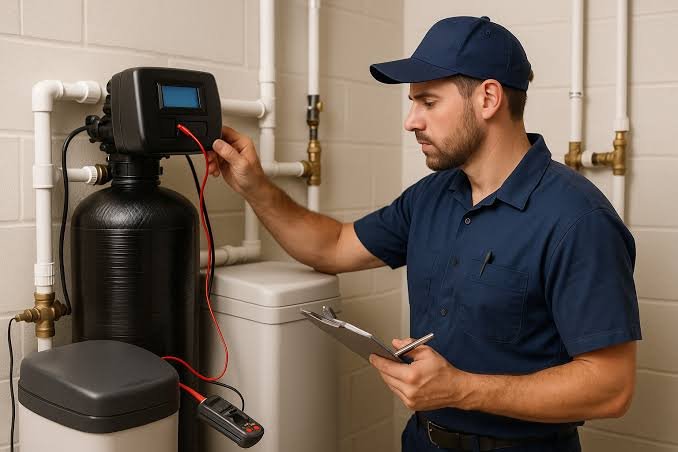
A professional installer can calculate this using the water hardness, household demand and equipment specifications.
It’s one of those situations where a few minutes of proper sizing can make a big difference later.
Think About Regeneration
Regeneration is the process a traditional ion-exchange softener uses to restore its treatment capacity.
During regeneration, the system typically uses a salt solution to recharge the resin. Depending on the design, the process also uses water and sends wastewater to the drain.
Efficiency therefore matters.
Look for equipment that allows regeneration based on demand rather than forcing the system to regenerate at fixed intervals when it may not be necessary.
Salt efficiency is worth considering too. A system that uses excessive amounts of salt can become more expensive and inconvenient over time.
Ask the installer to explain how the unit determines when regeneration occurs and what the expected salt consumption is for your household.
Don’t Ignore Installation Requirements
A softener needs more than a tank sitting somewhere in the garage.
The installation may require access to the main water line, a suitable drain connection, electrical power, and enough space for the equipment and routine maintenance.
The location also matters. Equipment should be reasonably accessible so that salt can be added and servicing can be performed without turning the job into an obstacle course.
If your home has unusual plumbing, limited space, or older infrastructure, mention that before choosing the system.
A good installer should assess the site rather than assuming every home is identical.
Maintenance Is Part of the Purchase
The initial equipment price is only one part of the cost.
Salt or potassium chloride may need to be replenished regularly. The resin tank, control valve, brine tank and other components may require inspection or servicing over time.
Ask what routine maintenance is recommended and whether the company provides ongoing service.
It’s also useful to understand which parts are considered consumables and how easy they are to replace. A system with readily available components can be much easier to live with than one dependent on specialized parts that are difficult to obtain.
Nobody wants a simple maintenance issue to become a weeks-long search for a replacement component.
Consider What You Actually Want to Improve
Before buying a softener, think about why you’re considering one.
Are you tired of mineral spots on fixtures? Is soap difficult to rinse? Are appliances showing signs of scale? Are you trying to protect plumbing or reduce cleaning?
Knowing your goal helps you evaluate whether a softener is the right solution.
If the main concern is chlorine taste, for instance, softening alone may not solve it. If sediment is the issue, filtration may be more appropriate. Sometimes several water-quality concerns exist at the same time, requiring a combination of treatment technologies.
The answer isn’t always another piece of equipment.
Choose for the Long Run
A water softener should ideally become a quiet part of the household rather than another appliance you constantly worry about.
That means choosing equipment with appropriate capacity, understanding its operating costs, and having a realistic maintenance plan.
Don’t be afraid to ask detailed questions before making a decision. How often will it regenerate? How much salt should it use? What happens during a power outage? How long is the equipment expected to last? What does servicing cost?
Clear answers are a good sign.
Ultimately, the best water softener isn’t necessarily the biggest, newest, or most heavily advertised model. It’s the one that matches your water, your household, and your actual needs.
Start with testing, look at real water use, consider installation and maintenance, and then make the decision. Once those pieces are in place, choosing a system becomes much less confusing — and your water treatment investment is far more likely to work the way you expected.