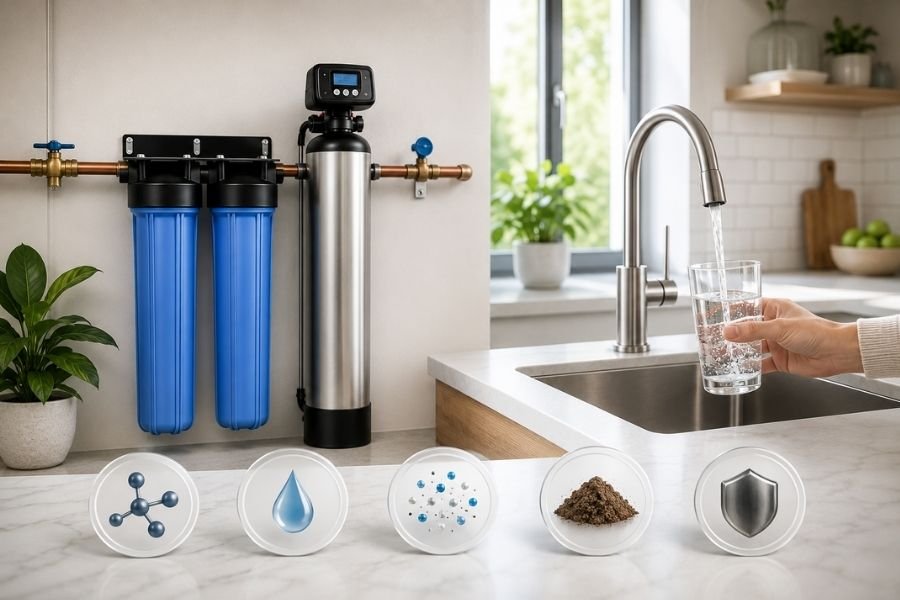
Most water problems don’t arrive with a dramatic warning. They tend to sneak into daily life. The shower suddenly smells a little odd. A glass filled from the kitchen faucet looks cloudy. Orange marks appear around the sink. Maybe the water leaves a strange taste behind that wasn’t there a few months ago.
It’s easy to shrug these things off. After all, water can look different depending on the glass, lighting or even the temperature. But persistent changes are worth investigating. Your water’s appearance, smell and effect on fixtures can provide useful clues about what’s happening inside your plumbing.
The important thing is not to guess. Different water-quality issues require different treatment approaches, and fixing the wrong problem can waste both money and time.
Start With a Water Test
The most sensible first step is testing the water.
A water test can reveal characteristics that aren’t visible to the naked eye, including pH, hardness, iron, sediment and other substances. This becomes especially important for homes using private wells, where water chemistry can vary considerably.
Even if your water comes from a municipal supply, testing can still help when you’re dealing with persistent taste, odor, staining or other unusual changes.
Think of testing as getting a diagnosis before buying the “medicine.” You wouldn’t replace a car battery because your headlights were dim without checking whether the alternator was the real problem. Water treatment deserves the same kind of common sense.
That Rotten-Egg Smell Has a Reason
Few water problems are as memorable as a sulfur smell. You turn on the faucet and suddenly the bathroom smells like someone has opened a carton of rotten eggs. Not exactly the spa experience.
When sulfur / smelly water occurs, hydrogen sulfide is often the culprit, although other factors can contribute to unpleasant odors. The source can vary, and the treatment approach depends on the concentration and water chemistry.
For some homes, treatment may involve oxidation and filtration. In other cases, a different approach may be more appropriate. A water professional can determine what is happening through testing and recommend equipment based on the actual conditions.
It’s also important to distinguish between a water-quality issue and an odor originating from a drain or plumbing component. Not every unpleasant smell is coming from the water itself.
Why Water Sometimes Looks Cloudy
Cloudy water can be unsettling, particularly when it appears suddenly. But cloudiness doesn’t always mean contamination.
Tiny air bubbles can temporarily make water look milky or white. Fill a clear glass and let it sit for a minute or two. If the cloudiness disappears from the bottom upward, trapped air may be responsible.
Persistent sediment / cloudy water, however, deserves more attention. Fine particles can enter water from wells, plumbing systems or disturbances in the water supply. Sediment may include sand, silt or other suspended material.
A sediment filter can help in situations where particles are the main concern. But once again, the correct filter depends on the type and amount of material involved.
Orange or Blue-Green Stains Tell Another Story
Water stains aren’t always just a cleaning problem.
Orange or reddish marks can point toward iron, while blue-green staining around fixtures may be associated with copper and potentially corrosive water conditions. When acidic / blue-green stains show up repeatedly, testing the water’s pH and related chemistry is a sensible move.
Acidic water can interact with plumbing materials and, depending on the circumstances, contribute to corrosion. Copper corrosion can produce blue-green deposits and may affect both fixtures and water quality.
The answer isn’t necessarily to install a standard filter. Treatment may involve adjusting water chemistry or using equipment designed specifically for the underlying condition.
Hard Water Leaves Its Own Fingerprints
Hard water is another common household complaint. Calcium and magnesium can leave white deposits around faucets and showerheads, create scale inside appliances and make cleaning more frustrating than it needs to be.
If you’ve ever cleaned a shower screen only to see cloudy spots return almost immediately, you’ve seen the effect firsthand.
Water softeners can reduce hardness minerals, while other systems may be designed to manage scale without removing hardness in the same way. The best choice depends on what you’re trying to accomplish.
It’s useful to remember that hard water and contaminated water aren’t automatically the same thing. Hardness is primarily a mineral issue, and treatment should be selected accordingly.
Don’t Choose Equipment Based on Appearance Alone
A common mistake is assuming that clear water must be clean and cloudy water must be unsafe.
Neither assumption is reliable.
Some dissolved substances are invisible. Conversely, temporary cloudiness can simply be air. That’s why visual inspection is useful for noticing changes, but it shouldn’t be treated as a complete water-quality assessment.
The same principle applies to treatment equipment. A large tank sitting in your garage doesn’t necessarily mean you have a better system. Technology should be matched to the water, flow rate and household requirements.
Think About Where the Problem Happens
Not every water issue needs whole-house treatment.
If the concern is limited to drinking and cooking water, a point-of-use system may be sufficient. If staining and odor affect every faucet, shower and appliance, whole-house treatment may make more sense.
Consider your actual water usage. A system should be sized for the household’s demand, especially during periods when several fixtures are operating simultaneously.
Installation conditions matter too. Space, plumbing layout, drainage and electrical requirements can influence what equipment is practical.
Maintenance Is Part of the Solution
Even a properly selected water-treatment system won’t maintain itself forever.
Filters need replacing. Treatment media can require servicing. Some systems need periodic cleaning or adjustments. Ignoring maintenance can gradually reduce performance and make it harder to notice when something has changed.
Before choosing a system, ask about the maintenance schedule. Find out what replacement components cost and whether servicing is straightforward.
A treatment system that fits your budget but becomes expensive or inconvenient to maintain may not be the best long-term choice.
When a Professional Opinion Is Worth It
Some water problems are simple enough to investigate yourself. Others are more complicated.
Persistent odors, recurring staining, sudden changes in water appearance or concerns about a particular contaminant are good reasons to seek professional testing. A qualified water-treatment specialist can evaluate the source water, interpret test results and explain which treatment options actually address the problem.
That last part matters. You don’t want to pay for a system that treats hardness when your real issue is iron, or install a basic sediment filter when dissolved contaminants are the concern.
Listen to What Your Water Is Telling You
Water doesn’t usually come with an instruction manual, but it does leave clues.
A smell, stain, cloudy appearance or mineral deposit can be a useful starting point. It doesn’t necessarily tell you exactly what’s wrong, but it tells you something has changed—or at least deserves a closer look.
The smartest approach is straightforward: test first, understand the problem, then choose treatment based on the results.
Good water treatment isn’t about buying the most expensive equipment or chasing every new technology. It’s about making a sensible decision for the water entering your home.
Once the right system is in place and maintained properly, those little warning signs can disappear into the background. The water smells normal. The glass looks clear. The fixtures stay cleaner. And, perhaps best of all, you stop thinking about your water quite so much—which is usually a sign that you’ve handled the problem properly.