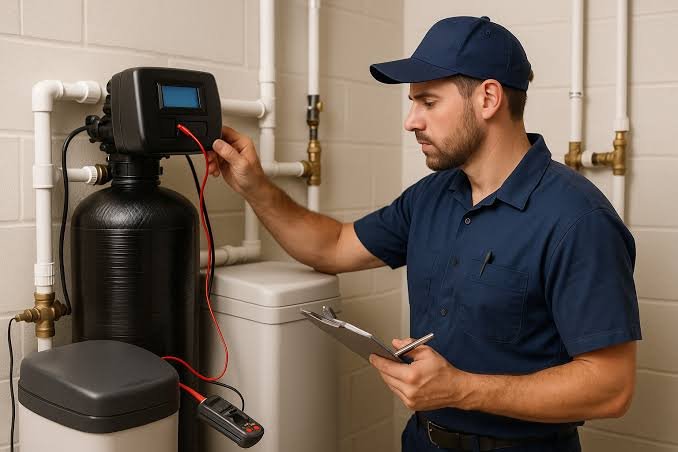
Water has a funny way of becoming invisible in everyday life. We use it to make coffee, wash dishes, take showers, fill pots, clean floors, and water plants without giving much thought to what is actually coming out of the tap.
Then something catches your attention.
Maybe there’s a strange taste in your glass. Perhaps the showerhead keeps collecting white scale. You might notice cloudy water after a plumbing change, or you’re simply concerned about what’s in your household water and want clearer answers.
That’s when choosing a treatment system starts to feel less like a home upgrade and more like a small investigation.
And honestly, that’s not a bad thing.
The best water-treatment decisions usually begin with understanding the water first. Once you know what you’re dealing with, the equipment becomes much easier to choose.
Don’t Start With Equipment — Start With Questions
Walking into a store and looking at water-treatment equipment can be overwhelming. There are filters, softeners, membranes, tanks, cartridges, UV units, and plenty of impressive-looking specifications.
It’s tempting to pick something and call it done.
But water treatment isn’t really a one-size-fits-all business.
Start by asking what bothers you about the water. Is it hardness? Taste? Odor? Sediment? A particular contaminant? Or are you mainly interested in improving drinking water?
Those answers matter because different treatment technologies solve different problems.
A system designed to reduce hardness won’t necessarily address every dissolved contaminant. Likewise, a basic carbon filter isn’t intended to handle every water-quality concern.
Knowing the problem saves money, time, and frustration later.
Testing Can Take the Guesswork Out
Homeowners sometimes rely on what they can see, smell, or taste. That’s understandable. If water looks perfectly clear, it feels clean.
But appearance doesn’t tell the whole story.
Some substances aren’t visible, and water can taste normal even when testing would reveal characteristics worth addressing.
That’s why water testing & analysis can be such a useful starting point. Testing can provide information about things such as hardness, pH, minerals, sediment, and other potential concerns, depending on the type of test performed.
A basic test may be enough for some households, while more detailed laboratory testing can make sense when there’s a specific concern.
The goal isn’t to panic over every number on a report. It’s to replace assumptions with useful information.
Hard Water Often Shows Up Slowly
Hard water is a good example of a problem that tends to sneak into daily life.
At first, you may simply notice spots on dishes or a white ring around the faucet. Then shower fixtures start looking dull. Soap seems to rinse differently. Over time, mineral scale can accumulate inside plumbing fixtures and water-using appliances.
Hardness is generally associated with calcium and magnesium.
A water softener can reduce those minerals through ion exchange, helping limit the scale associated with hard water.
The improvement can be subtle at first. You don’t necessarily wake up the morning after installation and feel like you’re living in a different house.
Instead, you notice little things. The shower door stays cleaner. The faucet doesn’t develop that stubborn crust quite as quickly. Cleaning feels a bit less tedious.
Sometimes that’s all you really wanted.
Drinking Water Deserves Its Own Conversation
The water used for washing clothes doesn’t necessarily need the same treatment as the water you drink.
For that reason, some households use whole-home treatment for general water-quality concerns and a separate point-of-use system for drinking and cooking.
Reverse osmosis drinking water systems are one option commonly used for this purpose. Depending on the equipment and membrane, reverse osmosis can reduce a range of dissolved substances from water.
These systems are often installed beneath a kitchen sink and connected to a dedicated faucet.
It’s a practical arrangement. You can have treated water available for drinking, cooking, tea, coffee, and other everyday uses without necessarily treating every gallon used for bathing or cleaning.
Don’t Assume Every Filter Does the Same Thing
The word “filter” can be misleading because it sounds universal.
It isn’t.
A sediment filter is designed to capture particles. Activated carbon can help with certain taste and odor issues and may reduce specific chemicals depending on the product. Other technologies are designed for particular contaminants or treatment goals.
This is why product specifications deserve more attention than flashy packaging.
If you’re concerned about a particular substance, look for evidence that the equipment is designed and tested to reduce it. Certifications can also provide useful information when comparing products.
And if you’re working from a water test, use those results to guide the decision.
A filter should have a job. If you can’t clearly explain what that job is, it’s worth stepping back before buying one.
Well Water Can Be a Different Story
Private well owners often have additional water-quality considerations because their water source isn’t managed in exactly the same way as a public municipal supply.
Depending on local geology and other conditions, well water can contain minerals, sediment, sulfur-related odors, bacteria, or other substances that require attention.
That doesn’t mean every well has a problem.
It simply means testing and regular monitoring can be especially valuable.
If the water changes noticeably — perhaps a new odor appears or sediment becomes more visible — don’t automatically assume the treatment system has failed. The source water itself may have changed.
Some Water Problems Need More Specialized Help
Not every issue can be solved with a basic filter or softener.
Certain homes may need treatment designed around iron, sulfur, sediment, bacteria, or other specific concerns. The right solution depends on what’s actually present and at what concentration.
This is where professional problem water solutions can become useful.
A qualified water-treatment provider can review testing results, assess the water source, and determine which treatment technologies are appropriate.
That doesn’t mean every recommendation needs to involve a complicated setup. Sometimes the answer really is quite simple.
The important part is matching the solution to the problem instead of treating symptoms blindly.
Maintenance Keeps Good Equipment Working
Once you’ve chosen the right treatment equipment, there’s still one thing that often gets overlooked: maintenance.
Filters have limited service lives. Reverse osmosis membranes eventually need replacement. Water softeners require routine attention. Other treatment components may need periodic inspection or cleaning.
Ignoring those tasks can gradually reduce performance.
A simple maintenance schedule can help. Write down when filters were changed and when the system was last serviced. Set reminders if necessary.
It doesn’t need to become a household obsession.
A few minutes every so often is usually enough to keep track of the basics.
Look Beyond the Initial Price
Price matters, but the cheapest system isn’t necessarily the least expensive over time.
Think about replacement filters, salt, electricity, professional servicing, replacement parts, and expected equipment life.
A system that costs a little more initially may have different ongoing requirements than a cheaper alternative.
Also consider support.
If something stops working six months after installation, will you know who to call? Are replacement parts easy to find? Is the equipment backed by a meaningful warranty?
Those questions aren’t particularly exciting, but they’re the kind you’ll be glad you asked later.
Better Water Starts With Better Information
It’s easy to get caught up in the technology.
Reverse osmosis, carbon filtration, softening, sediment removal — each has its place. But the equipment should come after the understanding, not before it.
Start with the water.
Test when appropriate. Pay attention to changes. Identify the actual concern. Then choose treatment designed around that concern.
You don’t need to turn your home into a laboratory, and you don’t need to buy every piece of equipment available.
You just need a sensible plan.
Water is one of those things we interact with constantly but rarely think about until something feels off. Taking the time to understand it can make treatment decisions clearer, maintenance easier, and everyday life a little more comfortable.
And when the tap works exactly as you’d expect, there’s something satisfying about that. No fuss. No second-guessing. Just water doing its job.